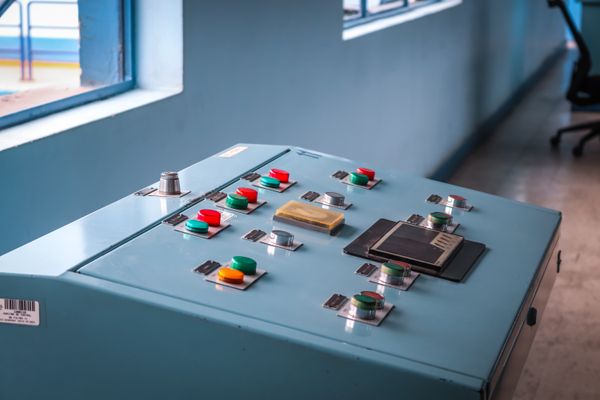
The plant sits 40 minutes outside Foshan, in a township the local economic zone has been quietly upgrading for a decade. R200M in revenue at exchange rates, supplying chassis subassemblies to a German tier-1 that supplies BMW, Daimler, and FCA. Two hundred and forty people on the floor across three shifts. Fourteen production lines.
I came to deconstruct what their predictive maintenance stack actually looks like. Not the Cognite-tier reference deployments you read about in white papers. The boring, workshop-grade implementation of an operation that pays for itself and would not, on its own, generate a press release.
The sensor estate.
Top-decile critical assets — 28 of them — carry full vibration + temperature + current instrumentation. That covers 6 hydraulic presses, 4 stamping units, 8 CNC mills, 5 robotic welders, and 5 ovens. Vibration sensors are PCB Piezotronics IEPE — about R1,800 each at volume, sampled at 51.2 kHz on each axis.
Temperature is K-type thermocouples on bearing housings + IR cameras on the press tables. Current signature analysis pulls from existing motor drives — no extra sensor, just better data discipline on the SCADA reads. The asset estate cost ~R740k to instrument fully. Three months of work for one electrical engineer and two technicians.
Below the top decile, the next 60 assets carry temperature + current only. Vibration is added opportunistically when an asset shows up in failure analysis. The plant's reliability lead calls this "earned coverage" — sensor capex follows incident pattern, not the other way round.
The historian + data layer.
Wonderware historian — five years of data, R420k licensing, locally hosted. The plant's IT team runs it on two HP DL380 servers in the plant compute room. Real-time data flows to a cloud-tier analytics platform via a 100 Mbps managed link to Tencent Cloud — but the historian itself stays on-prem, which the reliability lead is emphatic about.
The reason: connectivity to Tencent goes down 2–4 times a month for 15–90 minutes. The on-prem historian keeps everything running through the outages. Cloud is for analytics, not for the production-critical path. This is a pattern that translates 1:1 to African operations running on intermittent connectivity.
The model stack.
XGBoost is the workhorse for vibration regression — failure prediction on bearings, pump impellers, gearbox stages. Five-day forward horizon, retrained monthly. Each press has its own model — no cross-asset transfer, because the press dies wear differently per product mix.
Anomalib does the vision-AI on the inspection cameras over the stamping tables — catches workpiece defects at the line before they propagate to assembly. The reliability lead estimated this single layer saves ~R3.4M/year in scrap and rework.
What was new since my last visit a year ago: a Chronos forecasting layer added in Q4 2025. It consumes the same sensor data XGBoost uses but produces probabilistic forward forecasts — distributions, not point estimates. The reliability lead said this is the layer that finally convinced the COO to fund Phase 2 of the predictive program. "Probability bands made the risk story land."
The integration layer.
Failure forecasts don't live in a dashboard. They flow into the plant CMMS — a customised SAP PM instance — and auto-generate work orders. The maintenance team receives the work order in the daily standup the morning of, with the asset name, predicted failure mode, recommended intervention, and confidence band.
About 85% of work orders flow autonomously through to technician execution. The remaining 15% escalate to the reliability lead — usually because the forecast confidence is low or the failure mode is novel. The lead now spends ~30% of his time on escalations and 70% on system improvement, where two years ago the ratio was the inverse.
The capex sequence — what you can copy.
What South African tier-2 suppliers serving BMW SA, Mercedes SA, Toyota SA, and Ford SA can do in 18 months, in order:
- Month 1–3: Historian deployment. Wonderware or AVEVA PI. ~R400-600k. Get five years of forward archival running before touching any AI.
- Month 3–5: Top-decile critical asset instrumentation. Vibration + temperature on your 25–30 most critical assets. ~R700-900k.
- Month 5–8: XGBoost or LightGBM models on the top decile. Reliability engineer in lead, vendor partner support. Forecast horizon 5–10 days, retrained monthly. R450-650k including platform.
- Month 8–12: CMMS integration. Auto-generated work orders. Define autonomy thresholds. R300-500k including SAP PM customisation.
- Month 12–18: Vision-AI on critical inspection points. Then Chronos forecasting layer once XGBoost is mature and the reliability team is comfortable with probabilistic bands. R600-900k.
Total 18-month capex band: R2.5M–R3.6M. The Foshan plant recovered this in months 14–22 from measurable downtime reduction. Your operation will recover faster if you have stronger executive sponsorship (their CFO had to be persuaded twice; SA tier-2 plants typically have BMW-tier customer pressure baked in).
What does not translate: their Tencent Cloud link is replaced with Azure southafricanorth for SA ops, or AWS me-south-1 for Saudi tier-2 plants. The on-prem historian + cloud-analytics pattern translates exactly.
The takeaway for emerging-market tier-2 suppliers.
Foshan's tier-2 supplier is not running a Cognite-tier deployment. It is running a workshop-grade implementation that costs R3M, took 18 months, and pays for itself in year one. The technology stack — Wonderware + XGBoost + Anomalib + Chronos + SAP PM — is available anywhere. The discipline is what differentiates.
If you are an SA tier-2 supplier with OEM-driven OEE compliance pressure, the gap between you and Foshan is 18 months of executed program, not technology access. Foundry Cortex's recommended starting point is the readiness audit — it scopes which of the five sequencing steps above are already done at your operation, and which need work.