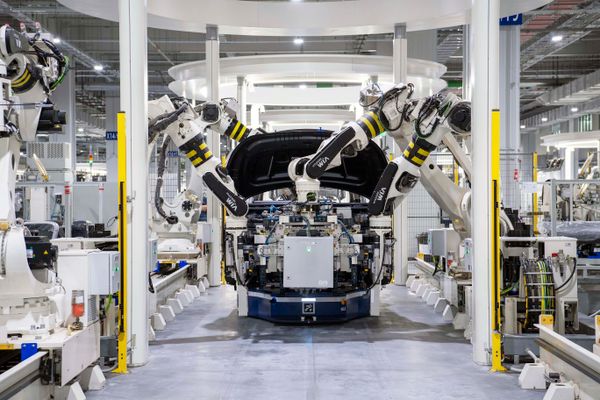
BMW Munich runs four Figure 02 humanoids on chassis subassembly work. This is the world's first humanoid deployment at production scale in automotive assembly, live since late 2024, with 18 months of operational data behind it. I was on-site for two days with BMW's advanced manufacturing team to understand what is actually happening on the floor, not what the press releases claim.
What I observed surprised me on three dimensions: the safety perimeter is more restrictive than the press coverage suggests; the productivity gains are real but in a narrower task set than Figure's marketing implies; and the integration burden is the work that actually matters and that BMW's team is quietly proud of.
The deployment scope.
Four Figure 02 units operate in a 14m x 22m cell on the chassis subassembly line. The work they do: bringing chassis components from a kitting station to the assembly point, positioning them for human-operated final fixture work, then returning to kit the next set. They are not driving the bolt guns. They are not making fixture decisions. They are doing the dexterous-fetch and sequential-positioning that previously consumed 30-40% of two human operators' time.
The cell is geofenced with a hard-stop perimeter — humans entering trigger immediate humanoid freeze. Inside the cell, the four humanoids coordinate spatially via a custom orchestration layer BMW built on top of Figure's API. The orchestration layer prevents two humanoids from approaching the same kit station simultaneously, manages queue priority, and handles error recovery.
The integration architecture.
This is where the work is. The Figure 02 units arrive with their on-board perception, motion planning, and basic task execution. They do not arrive integrated into the BMW line. The integration layer between Figure's API and the BMW MES (manufacturing execution system) took the BMW team roughly six months to build, with continuous tuning since.
The integration handles: kit availability messaging, fixture state machines, exception escalation to human supervisors, performance telemetry, and reinforcement signals back to the humanoid orchestration layer. The custom code is roughly 12,000 lines of Python + Java + some embedded firmware for the kitting station controllers. The BMW team I spoke with was clear that this is the work nobody talks about and the work that makes or breaks the deployment.
The safety model.
More restrictive than I expected. The geofenced cell is the primary safety control — humanoids simply do not operate while humans are inside. Press coverage of collaborative humanoid operation in shared spaces is, in 2026, still aspirational for production environments. BMW chose segregation because the failure-cost calculation favoured it: an injury incident would shut the deployment for months. Strict geofencing keeps the program running.
Inside the cell, the humanoids have multi-redundant collision detection — LiDAR + capacitive skin sensing + force-limited actuators — but the perimeter geofence is what passes German occupational safety review. For African operations evaluating humanoid deployment, this is the safety model to copy. Collaborative shared-space operation is on the roadmap; geofenced cell operation is the production-grade pattern in 2026.
The productivity gains.
Real but narrow. The four humanoids replace roughly 0.6 FTEs each across three shifts — so about 2.4 FTE displacement total. But the metric BMW tracks more carefully is cycle time on the subassembly station: down 8.5% versus the pre-humanoid baseline. The cycle time gain matters more than the labour displacement, because cycle time compounds across the line and the humans now do higher-judgment work upstream.
The press coverage suggesting humanoids will displace lines of operators is, in 2026, premature. What humanoids are actually doing at BMW is taking the dexterous-fetch and sequential-positioning work that bores humans, slows lines, and breaks operator wrists. The humans do the judgment work. The economic case is real; the form of the case is narrower than the discourse suggests.
Implications for African tier-2 suppliers.
BMW SA buys subassembly components from approximately 40 tier-2 suppliers in South Africa. Those tier-2 suppliers will, between now and 2030, face two pressures: (a) BMW Munich's cycle-time gains creating expectation that tier-2 suppliers match the upstream pace, and (b) humanoid deployment patterns becoming standard procurement playbook content from major OEMs.
What SA tier-2 suppliers can do now:
- 2026: Build the readiness foundation. Cycle-time baselining, kit station instrumentation, integration layer skill. None of this requires humanoids on the floor; all of it is precondition for humanoid deployment when it becomes economic.
- 2027: Pilot humanoid deployment on a single dexterous-fetch task. The economics start working at SA wage levels for tasks where injury rates make labour-substitution a safety conversation, not a cost conversation. Foundry Cortex's NVIDIA Inception partnership covers GR00T training for these pilots.
- 2028: Production deployment on the proven pilot pattern. By this point, vendor pricing has dropped, training models are mature, and the procurement risk premium has collapsed.
The mistake to avoid: trying to skip the readiness foundation. Tier-2 suppliers that wait until BMW SA mandates humanoid-equivalent productivity in 2028 will find themselves trying to deploy humanoids without the integration capability to make them productive. The integration layer is the work; humanoid acquisition is the cheap part.